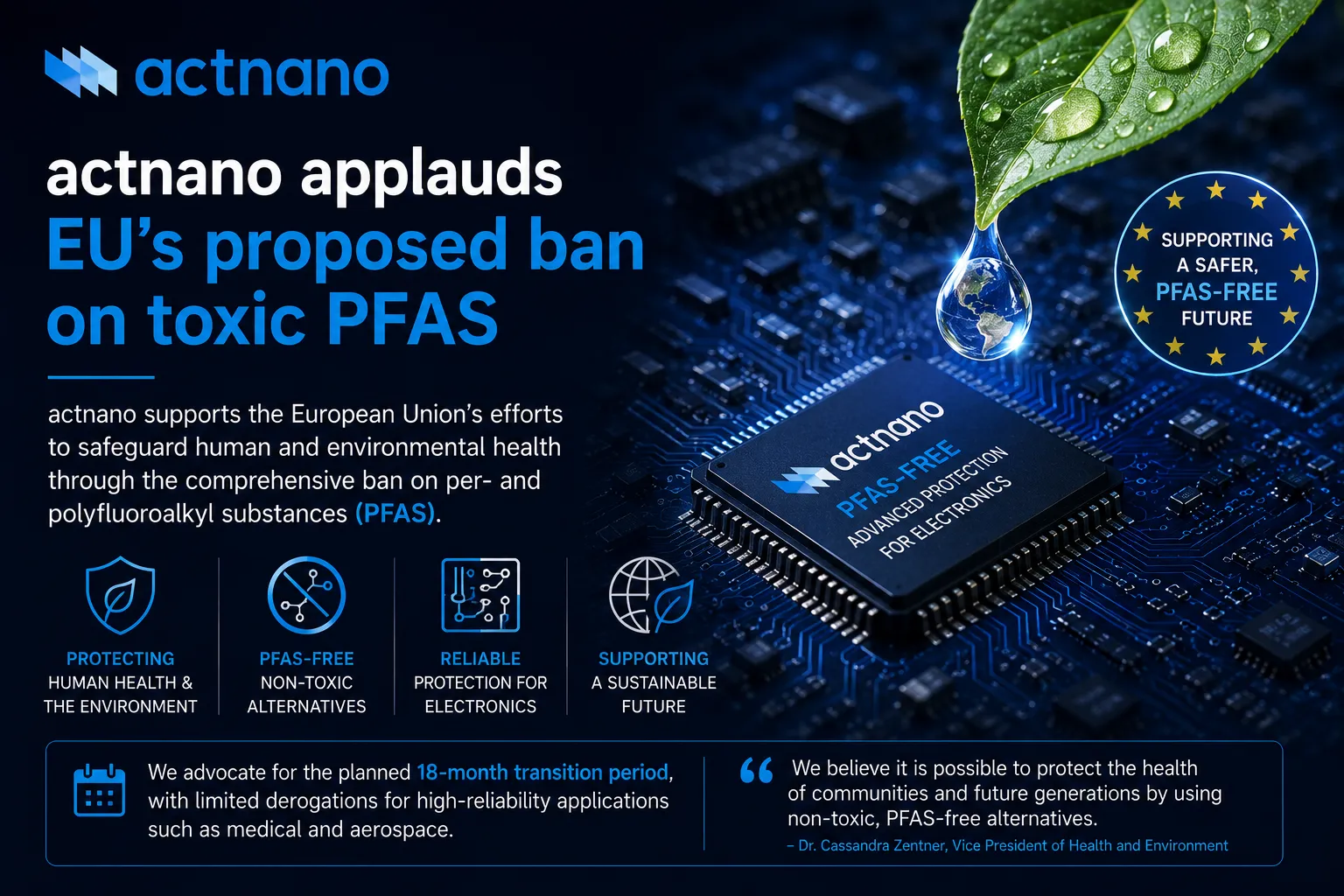
MALDEN Mass., October 23, 2023 – actnano, Inc., a global leader in surface protective technologies for automotive, consumer and industrial electronics, has submitted general comments in support of the proposal to restrict per- and polyfluoroalkyl substances (PFAS) in the European Economic Area.
“We applaud the effort made by the European Chemicals Agency to reduce PFAS in the environment and make products and processes safer,” said Dr. Cassandra Zentner, Vice President of Health and Environment at actnano. “We believe it is possible to protect the health of communities and future generations by using PFAS-free alternatives in place of these dangerous forever chemicals.”
Read actnano’s full comment below or access all General Comments here:
https://echa.europa.eu/documents/10162/4e3d00b8-9fe7-6763-7830-7305d7192ea4
actnano supports the European Union efforts to safeguard human and environmental health through the comprehensive ban on per- and polyfluoroalkyl substances (PFAS). The lack of regulation for these hazardous chemicals presents health risks on the global scale.
The electronics industry is one the major contributors to PFAS usage, as outlined in Table 1 of the Annex XV Restriction Report. A subset of that PFAS-usage in the industry is coatings for the environmental protection of electronics and electronic devices. Environmental protection is necessary to ensure the longevity and dependability of devices by preventing corrosion and also helps reduce electronic waste. Coatings are utilized in various areas to protect against corrosion, including on printed circuit board assemblies (PCBAs).
There are PFAS-free electronic coatings available on the market today that are readily used in consumer electronics, automotive, industrial and white goods markets. actnano manufactures such PFAS-replacements, which provide comparable environmental protection (please refer to the attached confidential comparison of actnano products vs competitor PFAS-containing coatings). Our products have undergone rigorous testing by our customers, meeting the highest performance standards and regulatory compliance, and demonstrating the ability to replace PFAS without compromising protection. Consequently, there are no performance barriers to eliminating PFAS-containing coatings from the majority of devices. It should be noted that further study is required to assess the replacement of PFAS-containing coatings in medical and aerospace applications, but this testing is currently underway.
While these products are available now, the time it takes to transition to replacement technology depends on the thorough performance testing conducted by product manufacturers to meet their stringent operational standards. If no modifications are necessary for the electronic devices themselves, it is feasible to test and implement alternative coatings during the 18-month transition period.
The coatings market and actnano are poised to replace PFAS in the supply chain, therefore we advocate for the planned 18-month transition period, with limited derogations for high-reliability applications such as medical and aerospace.